
Walk-in Trailer Freezing Units: A “Hub-Level” Solution for Mobile Cold Chain
Against the backdrop of rapidly growing demand for fresh e-commerce, pharmaceutical cold chains, emergency response, and large-scale outdoor event logistics, a type of equipment that combines large-capacity storage, mobility, and precise temperature control is moving from behind the scenes to center stage — the walk-in trailer freezing unit. By deeply integrating the core functions of traditional fixed cold storage into a trailer chassis, it transforms “refrigerated warehousing” from a site-specific asset into a mobile resource that can be deployed on demand and quickly relocated. Industry observers generally believe that this category is reshaping the form and logic of cold chain infrastructure.
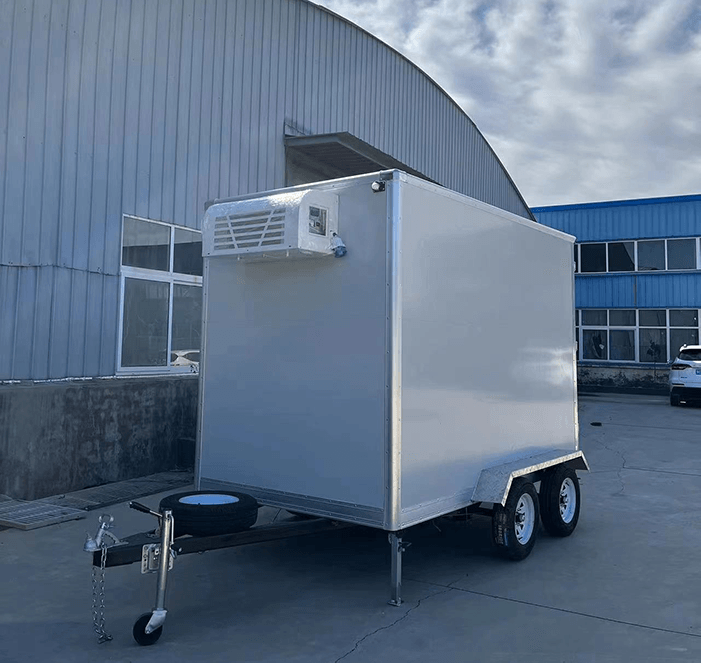
Technological Innovation: From Single-Purpose Refrigeration to Full-Scenario Adaptability
Early mobile refrigeration equipment was mostly limited to small insulated boxes or reefer trailers, offering limited space and single functions. Today’s walk-in trailer freezing units have achieved a qualitative leap in product design. Their interior clear height and depth are specially optimized, allowing operators to stand upright and easily access cargo, significantly improving loading and unloading efficiency. The refrigeration system adopts all-electric or hybrid solutions, enabling a wide temperature range to meet different needs from chilled preservation to deep freezing.
In terms of energy and structure, some advanced products incorporate solar-assisted power systems and high-density battery packs, allowing the unit to maintain set temperatures for extended periods even when disconnected from external power. The body materials have evolved toward all-fiberglass or high-strength composite insulation panels, eliminating the cold bridge effect caused by metal seams and greatly improving insulation performance and service life. At the same time, intelligent temperature control and remote monitoring systems have become standard, allowing users to view internal temperatures, door opening records, and equipment status in real time via mobile terminals, enabling reliable unattended operation.
Broad Application Scenarios: Filling the Gap of “Mobile Warehousing” in Cold Chain
The core value of walk-in trailer freezing units lies in their scenario adaptability. In agricultural production areas, they can serve as mobile field cold storage, pre-cooling and temporarily storing fruits and vegetables immediately after harvest, effectively reducing post-harvest losses. In densely populated urban areas, they can function as temporary replenishment centers for convenience stores and restaurants, or as community fresh food diversion stations. For large-scale temporary events such as sports tournaments, exhibitions, and music festivals, these units are critical infrastructure for ensuring the safe supply of food and beverages.
Moreover, walk-in trailer freezing units play an irreplaceable role in medical emergencies, vaccine distribution, and disaster relief. When fixed cold storage is damaged or loses power due to a disaster, self-propelled or towed freezing units can be rapidly deployed to provide reliable temperature-controlled environments for emergency supplies. Compared to traditional fixed cold storage, their essential advantage is not substitution but supplementation — flexibly responding to peak demand, filling infrastructure gaps, and bridging the “first mile” and “last mile” of the cold chain.
Industry Chain Collaboration: Customization and Modularity as Trends
As market awareness of walk-in trailer freezing units grows, industrial chain collaboration is deepening. Trailer chassis manufacturers, refrigeration unit suppliers, and insulation material companies are jointly launching modular design platforms. Users can choose different volume ranges, temperature zones, and energy configurations according to their specific business scenarios. Government authorities and logistics parks are also providing policy support, facilitating temporary land use permits, charging and maintenance facilities for mobile refrigeration equipment.
Current Challenges and Future Outlook
Despite promising prospects, the widespread adoption of walk-in trailer freezing units still faces some practical challenges. For example, in high-capacity, deep-frozen operating conditions, all-day operation places high demands on the reliability of electrically driven refrigeration systems. In extreme heat or severe cold regions, the matching between body insulation and the refrigeration unit requires more precise engineering calibration. Furthermore, how to establish a maintenance and emergency response network suitable for mobile warehousing equipment is a new challenge that the industry must address collectively.
Nevertheless, it is clear that walk-in trailer freezing units are no longer cheap substitutes for fixed cold storage. Rather, they are becoming key enablers for a more flexible, green, and intelligent cold chain logistics system. As product maturity increases and application scenarios expand, this category is evolving from a marginal auxiliary role into an indispensable mobile hub within the modern cold chain network. A new era of cold chain — more agile, more efficient, and more resilient — is accelerating with the arrival of these “walking cold storages.”