
The Shifting Landscape of Cold Chain Logistics: Portable Refrigerated Trailer Technology Reshapes the Transportation Map
Driven by the dual forces of a booming fresh-food e-commerce sector and increasingly stringent standards for pharmaceutical cold chains, the core equipment of road-based cold chain transport—the portable refrigerated trailer—is undergoing a comprehensive technological evolution, spanning everything from its power source to its control systems. This transformation represents far more than a mere equipment upgrade; it constitutes a fundamental redefinition of the efficiency and sustainability of the entire cold chain logistics ecosystem.
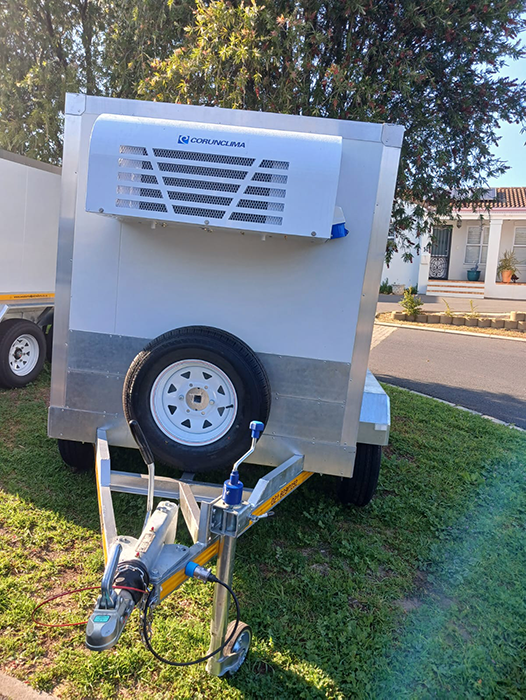
Bidding Farewell to the Roar: All-Electric Drive Ushers in an Era of Silent Cold Chains
For years, fleets of refrigerated trucks traversing city streets and highways have been accompanied by the ceaseless roar of auxiliary diesel engines. The refrigeration units in traditional trailers operate independently of the tractor unit's main engine, relying instead on small diesel generators to maintain low temperatures within the cargo compartment. This arrangement not only entails continuous fuel expenditures but also generates exhaust emissions and noise pollution—issues that become particularly problematic in urban centers and residential neighborhoods where environmental regulations are strictly enforced.
Today, this situation is being completely rewritten by all-electric refrigeration technology. The new generation of portable refrigerated trailers has entirely eliminated on-board diesel generators, shifting the power source for the refrigeration system to electricity. Whether drawing energy from the tractor unit's electric power take-off (ePTO) while in transit, or connecting to shore power facilities while parked at a depot, these trailers enable the refrigeration units to operate in complete silence. This technological breakthrough not only eliminates carbon emissions and noise pollution during operations but also simplifies vehicle maintenance procedures, creating cleaner and more compliant operating conditions for logistics enterprises.
Energy Cycling: Transforming Trailers into Self-Sufficient Mobile Cold Storage Units
Building upon the foundation of clean power sources, the next critical challenge in this technological evolution is to enhance the autonomy and flexibility of energy usage. The latest generation of refrigerated trailers is attempting to transcend the limitations of relying solely on external charging, exploring instead the possibilities of energy self-sufficiency.
The introduction of kinetic energy recovery technology offers an innovative pathway toward this goal. By installing energy recovery devices on their axles, these refrigerated trailers can capture kinetic energy—which would otherwise be dissipated as heat—during deceleration or while traveling down long inclines, converting it into electrical energy to be stored within on-board energy storage units. This "waste-to-value" energy recycling model enables the trailer to continuously replenish its power supply during long-haul transit, significantly extending the duration of pure-electric refrigeration operations when disconnected from external power sources.
Concurrently, solar photovoltaic technology is becoming deeply integrated with refrigerated trailers. The expansive, flat surface area atop the trailer body serves as an ideal platform for mounting lightweight photovoltaic modules. Under conditions of ample sunlight, these solar panels can directly provide supplementary power to the refrigeration system—even maintaining the interior temperature continuously while the vehicle is stationary. The synergistic application of these two clean energy technologies is driving the evolution of refrigerated trailers toward becoming highly energy-autonomous mobile cold storage units, fundamentally transforming their traditional role as merely passive energy-consuming devices.
Precision Sensing: Intelligent Temperature Control Reshapes Cold Chain Service Standards
If the revolution in power systems addresses the question of *how* to generate cold, then the penetration of intelligent control technologies is redefining the service standards regarding the *quality* of that refrigeration. With the maturation of IoT and sensor technologies, the interior environment of portable refrigerated trailers is becoming increasingly transparent and controllable.
Traditional temperature control methods often rely on a single temperature sensor and rudimentary on/off switching mechanisms; consequently, actual temperatures at different locations within the trailer can vary significantly, making it difficult to guarantee cargo quality throughout the entire journey. In contrast, a new generation of intelligent refrigerated trailers is equipped with a distributed sensor network capable of collecting real-time temperature data from every zone within the trailer. Utilizing intelligent algorithms, these systems automatically adjust refrigeration output and airflow circulation. This level of granular control ensures temperature uniformity from the front of the trailer all the way to the rear doors, providing a consistently stable storage environment even for sensitive cargo—such as fresh produce or pharmaceuticals—when the trailer is fully loaded.
The integration of remote monitoring and management platforms extends this transparency even further, reaching the dispatch centers of logistics enterprises. Managers can access real-time temperature profiles, refrigeration unit operational status, and energy storage unit charge levels for every trailer currently in transit, at any time. Furthermore, automated early-warning mechanisms for anomalous conditions enable timely intervention to mitigate potential risks *before* any cargo is compromised, thereby elevating the quality assurance capabilities of cold chain logistics to unprecedented heights.
Flexible Adaptation: Last-Mile Urban Delivery Drives Breakthroughs in Miniaturization
While long-haul trunk transportation is rapidly advancing toward a greener and more intelligent future, the "last mile" of urban distribution presents a distinct set of technical requirements for refrigerated transport equipment. Faced with narrow streets, aging residential complexes, and the time-critical demands of instant delivery services, traditional large refrigerated semi-trailers often prove inadequate. Consequently, agile and maneuverable small-scale refrigerated transport equipment is now seizing a significant opportunity for growth.
Designed specifically for urban distribution scenarios, this new generation of refrigerated equipment prioritizes vehicle maneuverability and adaptability while maintaining robust cooling capabilities. Its compact body design allows it to navigate complex urban road networks with agility, while its deep-cooling capacity remains sufficient to meet the stringent low-temperature requirements of products ranging from ice cream and premium fresh produce to certain biological agents. This miniaturized, highly mobile refrigerated solution bridges the equipment gap between trunk-line cold chain networks and end consumers, enabling high-quality temperature-controlled services to truly reach local communities and households.
A Vision of the Future: A New Cold Chain Ecosystem Woven from Green and Intelligent Technologies
A review of the current technological evolution of portable refrigerated trailers reveals two distinct trends: First, a comprehensive shift toward clean energy sources—replacing fossil fuels with electric propulsion and integrating diverse energy forms such as kinetic energy recovery and solar power. Second, a deep integration of intelligent control systems—replacing rudimentary manual operations with precision sensing and remote management capabilities to ensure that cargo quality remains fully controllable throughout the entire journey.
The profound significance of this technological transformation extends beyond merely providing cold chain logistics enterprises with more efficient transport tools; it also lies in driving the sustainable development of the entire supply chain ecosystem. Reductions in food waste, enhanced pharmaceutical safety, and energy conservation will all be gradually realized as this new generation of refrigerated equipment becomes more widely adopted.
For logistics enterprises currently navigating this era of transformation, paying close attention to—and actively adopting—advanced refrigerated trailer technologies is no longer merely a passive response to environmental compliance pressures; it represents a strategic imperative for future market competitiveness. In this emerging ecosystem, where green and intelligent technologies are inextricably intertwined, those who take the initiative to master these technological shifts will be best positioned to secure a leading edge in the next phase of cold chain logistics development.