
DC Electric Air Conditioning for Ambulances: Technological Innovation Empowering Pre-hospital Emergency Care
Within emergency medical service systems, ambulances have long transcended the role of mere "transport vehicles," evolving into "mobile emergency rooms" that integrate patient monitoring, life-saving interventions, and transport. This functional upgrade imposes rigorous demands on the vehicle's internal environment; factors such as temperature, humidity, air cleanliness, and even noise levels directly impact the stability of critically ill patients' vital signs and the operational efficiency of medical personnel. In recent years, the rapid adoption of DC electric air conditioning systems has emerged as a key technological driver, enabling ambulances to transition from simply meeting hardware standards to providing a "healing environment."
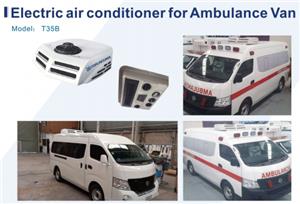
Independent Operation: Solving the Challenge of Stationary Climate Control
Traditional ambulance air conditioning systems are typically powered by the vehicle's internal combustion engine; consequently, the system ceases to function once the engine is turned off. However, in real-world emergency scenarios, medical personnel often need to perform prolonged life-saving procedures while the vehicle is stationary. Without an active system, the temperature inside the enclosed cabin can rapidly spike or plummet, placing additional physiological strain on the patient and severely disrupting the flow of emergency care. The core breakthrough of DC electric air conditioning lies in its power source: it utilizes a brushless DC electric compressor powered independently by the vehicle's battery, operating entirely separately from the engine. Whether the vehicle is in motion, idling, or parked for an extended period, the system delivers consistent cooling or heating. This capability eliminates the dilemma of losing climate control when parked, ensuring the medical cabin remains within an optimal temperature range throughout the entire emergency process and providing a stable environment for pre-hospital treatment.
Zoned Precision Control: Balancing Driving Safety with Treatment Needs
Ambulance interiors are naturally divided into the driver's cabin and the medical cabin, areas with distinct environmental requirements: drivers need a cool environment to maintain alertness and responsiveness, whereas critically ill patients require a warm, stable, and therapeutic setting. Traditional single-zone air conditioning systems often struggle to satisfy both needs simultaneously. Modern DC electric air conditioning systems typically feature independent dual-zone control, allowing target temperatures to be set separately for the driver's cabin and the medical cabin without mutual interference. This capability for precise, zone-based climate control ensures driving safety during long-distance patient transfers while maintaining a microclimate within the medical compartment tailored to the patient's condition—creating ideal conditions for procedures such as IV administration, medication delivery, and patient monitoring. Furthermore, the electric compressor operates smoothly; combined with optimized airflow ducting and sound-insulating materials, this significantly reduces background noise in the medical compartment, fostering a quiet environment conducive to clear communication between medical staff and patients, as well as the accurate use of monitoring equipment.
Driving Transformation through Energy Efficiency and Low Maintenance Costs
From an operational standpoint, the economic benefits of DC electric air conditioning systems are significant. Unlike traditional fuel-powered air conditioners—which consume vast amounts of fuel when the engine idles—electric systems run on battery power while the vehicle is stationary. This results in vastly improved energy efficiency, particularly as ambulance fleets transition to electric powertrains. Additionally, the electric compressor features a simpler design than traditional mechanical compressors; with fewer moving parts, it offers lower failure rates and longer maintenance intervals, effectively reducing the long-term operational burden on emergency service centers. Environmentally, electric air conditioning produces zero exhaust emissions while stationary and significantly reduces noise and vibration. This aligns with urban noise regulations and supports the global healthcare sector's shift toward green, low-carbon operations. These combined advantages are driving the transition of electric air conditioning from a "forward-looking feature" to a standard requirement in ambulance procurement.
Continuous Technological Evolution: From Roof-Mounted Integration to Smart Inverter Control
In terms of engineering, DC electric air conditioning systems for ambulances have undergone continuous iteration. Roof-mounted integrated designs have become the mainstream choice; by housing the entire unit on the vehicle roof, manufacturers save valuable interior space in the medical compartment and avoid the wind resistance and noise issues associated with cab-top installations. Meanwhile, the introduction of smart digital controls and inverter technology allows the system to automatically adjust compressor speed and airflow based on real-time interior temperature, sunlight intensity, and occupant activity, striking a dynamic balance between precise temperature control and energy efficiency. Some advanced systems even offer remote pre-cooling or pre-heating capabilities, allowing the medical compartment to reach the desired temperature via charging stations or fleet management platforms before the vehicle departs, thereby further enhancing emergency response efficiency.
As new energy chassis technology matures and battery energy density increases, the operational range and reliability of DC electric air conditioning systems will continue to improve. It is foreseeable that this technological innovation will continue to empower pre-hospital emergency care systems, transforming every ambulance into a truly temperature-controlled, quiet, and hygienic "mobile island of life," thereby providing a treatment space that is both higher in quality and more humane for patients and medical personnel alike.