
Portable Refrigerated Trailers Accelerate the Green Transition: A New Solution for "Last-Mile" Zero-Emission Cold Chain Logistics
Driven by the sustained growth of global fresh food e-commerce, outdoor activities, and emergency support needs, portable refrigerated trailers—key assets for flexible cold chain distribution—are undergoing an unprecedented technological transformation. Recently, several leading manufacturers have launched new generations of electric and intelligent refrigerated trailer solutions. The industry is rapidly shifting toward zero emissions, quiet operation, and remote smart control, offering cleaner, more efficient solutions for the "last-mile" of urban cold chain logistics.
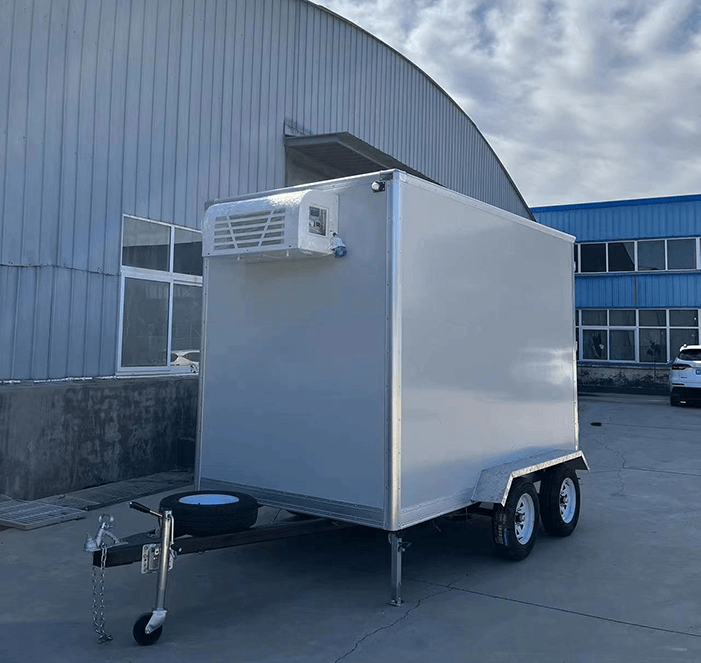
Electrification: Overcoming the Limitations of Traditional Fuel Power
Traditional portable refrigerated trailers largely relied on diesel engines or external fuel-powered generators to drive their cooling units; these methods not only generated noise and exhaust emissions but also incurred costs related to refueling and maintenance. In recent years, with the maturation of battery energy storage technology and solar-assisted charging systems, fully electric refrigerated trailers have reached the stage of practical application. These new products typically feature a combination of high-capacity lithium battery packs and roof-mounted solar panels, allowing for continuous battery recharging during parking or transit, which significantly extends the cooling runtime on a single charge. Furthermore, these systems support charging via standard mains outlets—eliminating the need for specialized charging stations—thereby lowering the barrier to adoption.
Technological Upgrades: Quiet, Precise, and Zero-Emission
From an environmental perspective, electric cooling systems achieve zero on-site emissions, making them particularly suitable for environmentally sensitive areas such as city centers, residential neighborhoods, and large event venues. Operating noise is also significantly lower than that of traditional fuel-powered units; operations can take place at night or early in the morning without disturbing nearby residents or disrupting the atmosphere at events. For goods highly sensitive to temperature fluctuations—such as pharmaceuticals and vaccines, premium fresh produce, and flowers—these trailers can be equipped with intelligent temperature control systems. These systems transmit real-time internal temperature data and trigger automatic alarms if readings deviate from set parameters, ensuring full traceability of temperature control throughout the process.
In terms of application scenarios, the flexibility of portable refrigerated trailers is being fully realized. Beyond restocking supermarkets and facilitating fresh food home delivery, these units are widely used to preserve food and beverages at outdoor music festivals and sporting events, store medicines and emergency supplies during disaster relief operations, and provide daily meals at remote mining sites or construction zones. Trailer sizes range from compact single-axle models to large dual-axle versions, with temperature control capabilities spanning freezing, refrigeration, and constant-temperature modes to meet the diverse needs of various sectors.
Expanding Use Cases and Future Trends: Smart Operations and Low-Carbon Policies
Simultaneously, the industry is actively exploring lightweight materials and modular designs. By reducing the trailer's curb weight without compromising thermal insulation performance, operators can lower the towing vehicle's energy consumption and boost overall operational efficiency. Some high-end models now feature remote diagnostics, allowing maintenance personnel to monitor refrigeration system status via mobile devices, anticipate potential issues, and minimize the risk of unexpected downtime.
On the policy front, many countries and regions have implemented or are drafting stricter emissions regulations for non-road mobile machinery, placing increasingly tight restrictions on traditional fuel-powered refrigeration units. This has driven cold chain logistics companies to accelerate the phase-out of older trailers in favor of leasing or purchasing electric refrigerated trailers. Some logistics platforms have even begun using the use of "green refrigeration equipment" as a criterion for supplier qualification, encouraging carbon reduction efforts across the entire supply chain.
Looking ahead, portable refrigerated trailers will evolve from simple "mobile cold storage units" into intelligent cold chain nodes connecting production sites, warehouses, and end consumers. With ongoing breakthroughs in solid-state battery technology, high-efficiency variable-frequency compressors, and direct-drive photovoltaic solutions, these units are poised to deliver extended operating ranges, lower costs, and greater performance stability. The industry generally anticipates that fully electric, ultra-quiet, long-range portable refrigerated trailers will soon become the standard for urban cold chain distribution, contributing tangible value to global food waste reduction, safe pharmaceutical distribution, and the development of low-carbon cities.
Though a niche segment of the cold chain, this sector is vital to public well-being and environmental sustainability. Amid the wave of green transformation, every incremental technological innovation in portable refrigerated trailers paves the way for a more sustainable future.