
Mobile Cold Chain: Portable Refrigerated Trailers Become a New Favorite in the Supply Chain
With the booming development of global food trade, increasingly stringent pharmaceutical cold chain standards, and the continued growth in emergency logistics demand, a flexible and efficient solution—portable refrigerated trailers—is emerging from the background, becoming an indispensable key player in the modern logistics system. This type of equipment not only redefines the concept of "mobile cold storage" but also brings revolutionary changes to the transportation and storage of temperature-sensitive goods with its user-friendly design and green energy philosophy.
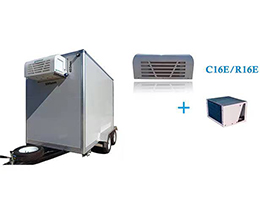
Filling the Gap: Flexibly Responding to Diverse Needs
Traditional cold chain logistics often relies on a fixed combination of large cold storage facilities and long-haul refrigerated trucks. This model often proves inadequate when facing temporary, sudden, or dispersed refrigeration needs. For example, temporary storage during peak seasonal agricultural harvests, catering support for large outdoor events, or vaccine transportation during public health emergencies all require refrigeration equipment to be available "on demand." The emergence of portable refrigerated trailers precisely fills this market gap. It's like a freely movable cold storage unit, capable of being towed to any location where needed, whether it's a bustling outdoor music festival, a tense and orderly emergency rescue scene, or a busy urban distribution center. It can be plugged in and used immediately, quickly establishing a stable and reliable low-temperature environment.
Human-centered design: A dual improvement in loading and unloading efficiency and safety
Recently, technological innovation in refrigerated trailers has focused on two core directions: human-centered operation and energy sustainability. In terms of improving operational convenience, the application of ground-level loading and unloading technology is undoubtedly a milestone breakthrough. Traditional refrigerated trailers often require loading and unloading platforms or forklifts, and goods need to undergo a "lifting" or "lowering" process before entering the compartment. This not only increases equipment costs but also extends loading and unloading time. Trailers equipped with the new ground-level loading system have a floor level with the ground, allowing workers to directly push goods smoothly into the compartment using handcarts or pallet jacks. This design greatly simplifies the loading and unloading process, not only improving efficiency but also fundamentally eliminating safety hazards such as slippage and tipping caused by differences in loading and unloading heights. It reflects the designer's deep consideration for the end-user's operational experience.
Green Revolution: Clean Energy Drives Zero-Carbon Cold Chain
Meanwhile, the green transformation of energy systems is accelerating. To break free from dependence on traditional diesel refrigeration and meet increasingly stringent environmental requirements in airports, urban areas, and other locations, new energy refrigerated trailers have emerged. By equipping themselves with large-capacity rechargeable battery packs, and even integrating photovoltaic power generation modules, these new refrigerated trailers can achieve fully electric-driven refrigeration. This means that during transportation or temporary storage, the refrigeration unit can achieve zero emissions and low noise. Even in the wilderness or warehouse corners without external power, it can maintain a constant temperature inside the compartment for extended periods using its own stored clean energy, ensuring the quality of goods. This green and quiet operating mode makes it an ideal choice for urban nighttime delivery and noise-sensitive locations such as hospitals and laboratories.
Smart Empowerment: From Transportation Tools to Intelligent Terminals
Even more noteworthy is that intelligent technologies are deeply empowering this field. Leveraging the Internet of Things (IoT) and cloud platforms, managers can monitor temperature fluctuations, battery levels, and equipment operating status within the trailers in real time. Each refrigerated trailer becomes a data node in the cold chain network. In the event of abnormal temperatures, equipment malfunctions, or doors not being properly closed, the system immediately sends alerts to managers via a mobile app or computer. This transformation from traditional passive transportation to proactive, visualized risk management provides a robust safety barrier for pharmaceutical reagents or high-end food products requiring strict temperature control, ensuring an uninterrupted supply chain "from warehouse to destination."
A Promising Future: Weaving a Dense Temperature Control Network
From street-side food delivery to transoceanic pharmaceutical cold chains, portable refrigerated trailers, with their unparalleled flexibility and reliability, are quietly weaving a denser and more resilient temperature control network. It's not just an upgrade to logistics equipment; it's a powerful boost to the overall social capacity for material supply. As the technology matures and application scenarios expand, these mobile "cool messengers" will play an even more vital role in future production and daily life.