
Bidding Farewell to the "Ordeal of Idling": DC Electric A/C Sets a New Standard for Ambulance Cabin Environments
In the race against time during emergency missions, maintaining the cabin environment while the vehicle is stationary has long been an "invisible battleground." With traditional fuel-powered ambulances, maintaining cooling or heating in the medical compartment while parked required the engine to idle continuously. This not only caused massive fuel waste and mechanical wear but also introduced engine vibrations and exhaust fumes directly into the emergency scene—pain points that compromised the precision of medical personnel and the comfort of patients. In recent years, driven by the adoption of new energy chassis technology and upgrades to vehicle electrical systems, an independent DC electric air conditioning system has quietly transformed this landscape, infusing these mobile "arks of life" with a breath of cool, green vitality.
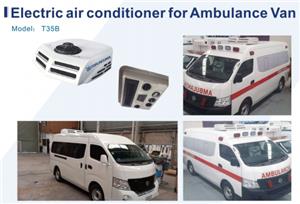
A Technological Breakthrough: From "Engine-Dependent" to "Independent, Precise Control"
The core innovation of the DC electric air conditioning system lies in the shift of its power source. Instead of relying on the internal combustion engine to drive a mechanical compressor via a pulley, the system draws high-voltage DC power directly from the vehicle's battery pack to operate an independent electric scroll compressor. This seemingly simple change in energy flow effectively decouples the air conditioning system from the vehicle's driving state.
In emergency scenarios, this means the temperature and humidity within the medical compartment remain constant, even during prolonged standby, traffic congestion, or frequent door openings while loading and unloading patients. Technically, these new-generation systems typically employ variable-frequency control technology; they automatically adjust compressor speed based on the temperature differential between the cabin interior and exterior, as well as solar radiation intensity, to deliver cooling output precisely as needed. Unlike traditional fixed-frequency systems—which cause temperature fluctuations due to frequent cycling on and off—DC variable-frequency systems keep cabin temperature variations within a very narrow range. This offers significant clinical benefits for critically ill patients who require stable body temperatures.
An Elevated Experience: Combining Noise Reduction with Enhanced Efficiency
Beyond improved temperature control, the DC electric air conditioning system delivers a revolutionary improvement in noise reduction. With traditional engine idling, the roar of the engine and the noise of the mechanical compressor combine to create high noise levels within the medical compartment; this not only interferes with medical personnel using stethoscopes for initial diagnoses but also exacerbates patient anxiety and discomfort. In contrast, the independent operation of an electric air conditioning system eliminates the engine—the primary noise source—entirely; even when the compressor runs at full capacity, only the soft sound of airflow enters the cabin. This quiet environment creates ideal acoustic conditions for communication between medical staff and patients and for interpreting ECG waveforms, thereby subtly enhancing the quality of pre-hospital emergency care.
Simultaneously, the independent air conditioning system facilitates zoned temperature control for the driver's cab and the medical compartment. Emergency vehicles often face scenarios requiring vastly different temperatures in the front and rear sections—needs that are difficult to balance with a traditional single-system setup. Now, a dual-evaporator, dual-duct design combined with independent electronic control logic ensures the driver enjoys a clear, fog-free view, while the medical team in the rear can flexibly adjust the temperature to the patient's comfort level, achieving precise care through a "dual-environment" setup.
Green Transition: Implementing "Dual Carbon" Goals in Emergency Services
From a broader perspective, the widespread adoption of DC electric air conditioning represents a crucial step in the full electrification of public service vehicles. For emergency centers, eliminating engine idling means zero emissions and minimal heat radiation at the scene—benefits that are particularly valuable in challenging environments such as underground garages, narrow alleyways, or enclosed ambulance bays. This not only removes the health risks posed by exhaust fumes to bystanders but also reduces the incidence of secondary mechanical issues caused by prolonged idling—such as engine carbon buildup and catalytic converter clogging—thereby lowering fleet maintenance costs over the vehicle's entire lifecycle.
As vehicle battery energy density increases and thermal management systems are continuously optimized, DC electric air conditioning is rapidly transitioning from a premium option to a standard feature. Industry experts predict that future ambulance air conditioning systems will evolve beyond mere comfort components; instead, they will function as "temperature control brains" deeply integrated into the vehicle's intelligent thermal management system, coordinating with battery thermal management and motor waste heat recovery to maximize energy efficiency. It is foreseeable that, driven by both technological advancements and the needs of the public, DC electric air conditioning systems will—through quieter, more precise, and greener operation—safeguard every race-against-time life-saving mission. These systems ensure that the journey of emergency care is not only swift but also smooth and comfortable for the patient. This represents not merely an evolution in automotive air conditioning technology, but a heartwarming enhancement of the human-centric care defining modern emergency medical services.