
Ambulances Driving into the Future: DC Electric Air Conditioning Ushers in a Silent Revolution in Life-Saving
On a city street in the afternoon, a white ambulance glides silently by, without the roar of a traditional engine, only the silent flashing of the blue warning lights on its roof. Inside, a heart patient is breathing steadily, completely unaware that the ambulance is opening a lifeline for him with groundbreaking silent technology.
Late at night on the city streets, the emergency center receives an urgent call. A few minutes later, an ambulance quietly arrives at the scene, without the roar of an engine, only the flashing blue lights on its roof indicating its presence. When the medical personnel gently lift the patient into the vehicle, the sound of them closing the door is quieter than usual—because this ambulance is undergoing a silent technological revolution.
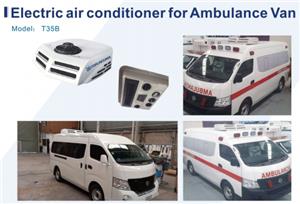
Silent Transformation
The ambulance, this mobile unit for life-saving, is undergoing a profound transformation from the fuel-powered era to the electric era. In this transformation, the DC electric air conditioning system plays a core role, becoming a key technology driving the evolution of ambulances from "transportation tools" to "mobile medical platforms."
In traditional ambulances, the air conditioning system relies on the engine to drive the compressor. This design not only increases the vehicle's energy consumption and noise but also limits the performance and reliability of the air conditioning system.
Especially when waiting for patients or during transport, the engine continuously runs simply to maintain the air conditioning, wasting fuel and generating unnecessary emissions and noise.
The new DC electric air conditioning system completely changes this model. It draws energy directly from the ambulance's electrical system, without the need for complex mechanical transmission devices.
This design change brings not only improved energy efficiency but also a revolution in the entire working environment of the ambulance. When the vehicle is stationary, the air conditioning system can operate quietly, without the roar of the engine interfering with communication between patients and medical personnel.
Green Heartbeat
The DC electric air conditioning system is like the "green heart" of the ambulance, providing stable and clean environmental support for the entire medical compartment.
This system adopts an innovative modular design, integrating cooling and heating functions in a compact space while maintaining efficient airflow circulation. The air intake and exhaust systems are carefully designed to ensure even airflow within the medical compartment, avoiding direct blowing on sensitive areas of the patient. During the transportation of infectious disease patients, the air filtration function of the air conditioning system is particularly important. Multi-layer filters can intercept airborne particles and pathogens, and when used in conjunction with a negative pressure system, they can effectively prevent the spread of pathogens within the medical compartment.
For critically ill patients, especially those with respiratory diseases, clean air circulation can directly affect the stability of their vital signs.
The precise temperature control capabilities of the DC electric air conditioning system provide personalized environmental support for different types of patients. Burn patients require a slightly cooler environment to prevent infection spread, while shock patients require a warm environment to maintain body temperature.
This precision in temperature regulation allows medical personnel to adjust the medical compartment environment according to the patient's specific condition, creating optimal conditions for treatment during transport.
Intelligent Collaboration
With the popularization of 5G technology and the Internet of Things, ambulances are gradually integrating into smart healthcare networks. The DC electric air conditioning system is no longer an isolated device in this process, but an integral part of the intelligent medical environment.
Through connection with on-board medical equipment and telemedicine systems, the air conditioning system can automatically adjust its operating mode based on patient vital sign data.
When the system detects an abnormal body temperature, it can automatically adjust the air conditioning settings to assist medical personnel in temperature management. This intelligent collaborative capability greatly reduces the workload of medical personnel, allowing them to focus more on emergency treatment of patients.
With the development of autonomous driving technology, future ambulances may achieve highly automated operation. The DC electric air conditioning system will adapt to this trend, deeply integrating with other vehicle systems.
When an autonomous ambulance is en route to a rescue location, the air conditioning system can be pre-activated to adjust the medical compartment to environmental conditions suitable for most emergency patients; when the vehicle returns to base, the system can automatically perform cleaning and disinfection cycles, preparing for the next mission.
Humanized Space
The environment inside an ambulance often means stress, fear, and discomfort for patients. The emergence of the DC electric air conditioning system is changing this traditional impression, transforming ambulances into more humane medical spaces.
Quiet operation is one of the most significant features of the DC electric air conditioning system. Traditional ambulances suffer from noise not only from the engine but also from vibrations and the operation of the air conditioning system.
The almost silent operation of the electric air conditioning system creates a much quieter environment for patients. This quiet operation can alleviate patients' anxiety and allow medical staff to auscultate and communicate with patients more clearly.
Furthermore, the precise temperature control capabilities of the air conditioning system provide a more comfortable environment. Traditional air conditioning systems often experience temperature fluctuations, being either too cold or too hot, while DC electric air conditioning can maintain a more stable temperature environment.
For patients, this stability can provide psychological comfort – at their most vulnerable time, the environment is no longer an additional source of stress.
Industry Reshaping
DC electric air conditioning technology is not only changing the way individual ambulances operate but is also reshaping the entire medical vehicle industry ecosystem.
This transformation is driving new collaborations between automobile manufacturers, medical equipment suppliers, and medical technology companies to jointly develop more integrated and optimized mobile medical solutions.
As the technology matures, the application range of DC electric air conditioning systems is constantly expanding. From regular ambulances to negative pressure ambulances, from mobile clinics to surgical vehicles, medical vehicles of different uses can benefit from this technology.
Especially in surgical and dental vehicles that require highly sterile environments, the precise environmental control capabilities of DC electric air conditioning systems are particularly important.
Looking ahead, with the continuous advancement of battery technology and energy management systems, the performance of DC electric air conditioning systems will be further improved. Longer operating times, faster temperature adjustment speeds, and more intelligent environmental sensing capabilities will make ambulances a more efficient and humane mobile medical space.
In future urban emergency medical networks, every ambulance will become a mobile life support unit. As they silently traverse city streets, the constant temperature and clean air maintained inside are no longer simply about environmental comfort, but have become an integral part of modern emergency medicine.
This seemingly ordinary technological innovation of DC electric air conditioning systems is driving the transformation of ambulances from transportation tools to mobile medical platforms.
When emergency personnel press the start button, there is no roaring sound, only the gentle lights on the dashboard illuminate, and the silent revolution in life-saving has arrived.