
A New Era of Cold Chain Logistics: Portable Refrigerated Trailers Usher in a New Era of Green and Intelligent Technology
Against the backdrop of the rapid upgrading of the global cold chain logistics industry, portable refrigerated trailers, serving as "mobile cold storage" connecting production sites and consumers, and pharmaceutical factories and patients, are undergoing a profound technological transformation. From energy iterations in power systems to leapfrog improvements in temperature control precision, and the full integration of remote management capabilities, this traditional transportation equipment is rapidly evolving towards green, intelligent, and efficient directions.
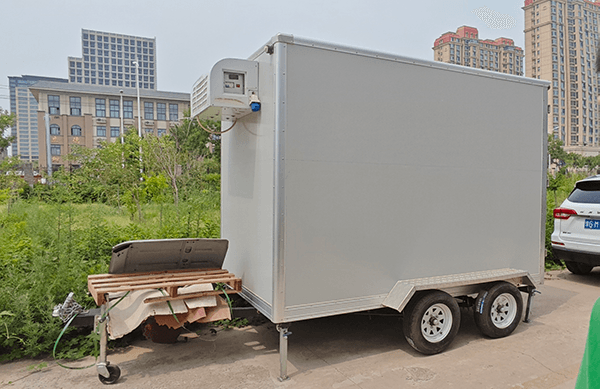
Green Power: Saying Goodbye to Diesel Dependence
For a long time, the refrigeration systems of refrigerated trailers have relied heavily on independent diesel engines, resulting in continuous carbon emissions and significant noise pollution. With the increasing global emphasis on sustainable development, new energy technologies are rapidly entering this field.
In recent years, leading companies in the industry have launched refrigerated trailers using pure electric refrigeration systems. These new products no longer use traditional diesel generator sets but instead achieve full electric drive through onboard energy storage devices and energy recovery technology. In urban delivery and nighttime operations, electric refrigerated trailers demonstrate significant advantages: zero emissions help reduce urban air pollution, while their low noise characteristics allow them to overcome the limitations of nighttime driving and loading/unloading times, improving logistics efficiency.
Meanwhile, new energy technologies are showing diversified development directions. Some companies are beginning to explore combining photovoltaic power generation systems with refrigerated trailers, utilizing the space on the roof of the trailer to install solar panels and provide power support for auxiliary equipment. Other companies are trying to introduce energy storage module expansion technology, enabling the trailer to maintain low-temperature operation for longer periods without external power. These innovations are expanding the application boundaries of portable refrigerated trailers, allowing them to play a greater role in scenarios such as large event venues, disaster relief areas, and remote construction sites.
Precise Temperature Control: Safeguarding High-Value Goods
With the popularization of fresh food e-commerce and the improvement of pharmaceutical cold chain standards, the market has placed higher demands on the precision of temperature control during refrigerated transportation. From high-end seafood and premium fruits to biological agents and vaccines, different goods have different sensitivities to temperature environments, and traditional "roughly constant temperature" is no longer sufficient.
The new generation of portable refrigerated trailers features refined management in their refrigeration system design. Multi-temperature zone control technology is becoming a development trend, allowing for the division of the same trailer into multiple independent spaces for freezing, refrigeration, and constant temperature, meeting the needs of transporting different types of goods in the same vehicle. Simultaneously, the density of temperature sensors has been significantly increased, and the optimized design of the airflow circulation system ensures uniform temperature distribution within the compartment, avoiding fluctuations in localized temperature zones.
More importantly, modern cold chain logistics has an increasingly lower tolerance for temperature fluctuations. New refrigerated trailers are generally equipped with rapid pre-cooling functions, quickly adjusting the temperature inside the compartment to the set value before loading, reducing the time goods are exposed to unsuitable temperature environments. This extreme pursuit of temperature control precision is becoming a core indicator for evaluating the quality of refrigerated transport equipment.
Intelligent Interconnectivity: Making "Mobile Cold Storage" Visible and Controllable
If the power system and refrigeration technology are the "body" and "heart" of a refrigerated trailer, then the intelligent management system is becoming its "nervous system." The deep application of Internet of Things (IoT) technology ensures that portable refrigerated trailers are no longer information silos in the logistics chain.
With the help of onboard sensors and remote communication modules, operators can obtain multi-dimensional data about the trailer in real time: real-time temperature of various areas inside the compartment, operating status of the refrigeration unit, vehicle location, door opening records, etc. This information is synchronously transmitted to a cloud management platform, where data analysis generates visualized reports such as temperature curves, anomaly alarms, and energy consumption statistics.
For cold chain logistics companies, this transparent management means early warning of risks and rapid traceability of problems. Once abnormal fluctuations occur in the compartment temperature, management personnel can receive immediate notification and intervene promptly to prevent cargo damage. In sectors with high compliance requirements, such as pharmaceutical cold chain logistics, automatically recorded temperature data can also be directly used for regulatory verification, simplifying compliance processes.
Materials Innovation: Continuous Breakthroughs in Insulation Performance
The insulation performance of refrigerated trailers directly affects refrigeration efficiency and energy consumption levels. In recent years, lightweighting of the compartment materials and improvement of insulation performance have become key areas of technological innovation.
The application of new composite materials is changing the manufacturing process of refrigerated trailers. Compared to traditional metal trailers, trailers made from a composite of polymer materials and structural foam are not only lighter but also offer significantly improved insulation. The lightweight design means more cargo can be loaded within the same load limit, improving transportation economy; while the enhanced insulation reduces the frequency of refrigeration unit start-ups and shutdowns, helping to lower energy consumption.
Simultaneously, advancements in trailer sealing technology are reducing cold loss. High-strength sealing strips, anti-cold-bridge structures, and automatic door closing systems collectively create a more reliable insulation barrier. These seemingly minor improvements play a crucial role in long-distance transportation and the frequent opening and closing of doors.
Application Expansion: From Transportation Tool to Multifunctional Platform
As technology upgrades, the functional positioning of portable refrigerated trailers is also quietly evolving. They are no longer merely transportation tools connecting warehousing and terminals but are gradually becoming independently operating mobile cold storage facilities.
In the food service industry, portable refrigerated trailers are used as temporary storage for event venues, providing food preservation support for large banquets and outdoor festivals. In the medical field, this type of equipment can be rapidly deployed to vaccination sites or emergency medical facilities to ensure the safe storage of vaccines and medicines. In agricultural production areas, refrigerated trailers can be driven directly to the fields for rapid pre-cooling after harvesting, reducing spoilage of agricultural products.
This "use-and-go" flexibility is changing the traditional layout of cold chain networks. Businesses no longer need to invest in fixed cold storage facilities for temporary needs; they can meet peak demand by leasing or allocating portable refrigerated trailers, reducing fixed asset investment and improving resource utilization efficiency.
Looking to the Future
From the green transformation of power systems to continuous improvement of temperature control precision, and comprehensive upgrades of intelligent management and material processes, the technological iteration of portable refrigerated trailers is injecting new vitality into cold chain logistics. With the upgrading of fresh food consumption, the increased requirements for pharmaceutical safety, and the advancement of supply chain resilience construction, technological innovation in this field will continue to deepen. In the future, portable refrigerated trailers will play an even more important role in ensuring food quality, protecting pharmaceutical safety, and reducing food waste, becoming an indispensable key link in the modern logistics system.