
Safeguarding Lives with "Cool Comfort" While Parked: Breakthroughs in DC Electric Air Conditioning Technology for Ambulances
As my country's emergency medical system continues to raise its standards for patient transport comfort and safety, the ambulance—often dubbed a "mobile ICU"—is seeing the precise regulation of its internal environment emerge as a new focal point for technological innovation within the industry. Recently, a series of DC electric air conditioning products—developed specifically for new-energy ambulances and other specialized vehicles—have been successively introduced to the market. These innovations aim to resolve critical industry challenges, such as poor cooling performance and excessive energy consumption while the vehicle is parked during emergency operations, thereby providing a more stable and cool environment to safeguard the vital lifeline of emergency rescue.
Focusing on Emergency Scenarios: Solving the "High-Temperature" Dilemma
For ambulances tasked with pre-hospital emergency care, the cabin serves as more than just a space to accommodate medical staff and patients; it also houses a suite of sophisticated medical equipment, including ventilators, patient monitors, and infusion pumps. In the scorching heat of summer, the cabin's airtight design and the rapid heat absorption of its metal body cause internal temperatures to skyrocket quickly, placing significant physiological stress on critically ill patients who are already in a vulnerable state. Crucially, when emergency personnel are executing missions or providing on-site treatment, the vehicle is often idling or completely switched off. Under these conditions, traditional engine-driven air conditioning systems frequently fail to function effectively, leaving the medical cabin stiflingly hot—a situation that directly compromises the precision of medical procedures and the comfort of the patient.
Addressing the specific demands of these scenarios, a new generation of DC electric air conditioning systems designed for ambulances demonstrates exceptional adaptability. Tailored specifically for the electrical platforms of new-energy vehicles, these systems draw power directly from the vehicle's high-voltage traction battery, thereby completely eliminating any reliance on a running engine. Their core advantage lies in their robust cooling capabilities while the vehicle is parked; even amidst extreme external heat and with the cabin fully occupied by medical equipment and personnel, these systems can rapidly regulate the internal temperature to a comfortable level, ensuring a consistently stable environment for medical care.
Silence Meets Intelligence: Creating a Tranquil Healing Space
In the high-tension environment of an emergency scene, a quiet atmosphere is paramount for enabling doctors to perform auscultation effectively, facilitating clear communication between medical staff and patients, and helping to alleviate patient anxiety. While traditional engine-driven air conditioning systems generate significant noise when the vehicle is idling, the new DC electric air conditioning systems utilize intelligent variable-frequency control technology to strike an optimal balance between operational efficiency and noise suppression. Once the temperature inside the medical cabin reaches its preset target, the system automatically switches to a low-load operating mode. This not only significantly reduces energy consumption but also achieves a nearly silent operational state, thereby preventing mechanical noise from interfering with critical emergency care procedures.
Furthermore, some advanced units incorporate a fresh air function, capable of introducing filtered external air into the cabin as needed. This feature is of particular value for negative-pressure ambulances, helping to maintain air purity within the cabin and ensure the safety of both medical personnel and patients during the transport of individuals with infectious diseases. In terms of intelligent control, these air conditioning systems can be seamlessly integrated into the vehicle's overall control network via bus technology. This enables synchronized operation with the vehicle's original dashboard or a dedicated control panel, allowing medical staff to precisely adjust the cabin temperature without the need for complex manual operations.
Compact Design and Eco-Friendly Philosophy: Facilitating Vehicle Conversion and Upgrades
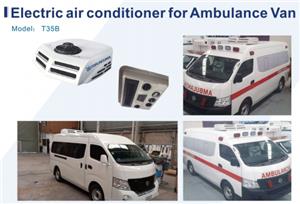
For ambulance conversion projects—where space utilization efficiency is paramount—the physical dimensions and ease of installation of equipment are critical considerations. New-generation DC electric air conditioning systems typically feature a compact, modular design; they are usually roof-mounted, ensuring they do not encroach upon the precious interior space of the medical cabin. Additionally, their exterior casings can be painted to match the ambulance's body color, ensuring a cohesive and aesthetically unified appearance for the entire vehicle.
Regarding environmental performance, these new-generation products actively align with global mandates for controlling greenhouse gas emissions by utilizing eco-friendly refrigerants, thereby embodying the philosophy of "green emergency care." Their factory pre-charged and "plug-and-play" design also significantly streamlines the installation process for vehicle conversion specialists and lowers the technical threshold for subsequent maintenance.
Industry Trends: Electrification Drives Technological Innovation in Specialized Applications
As the transition toward new-energy-powered ambulances accelerates—both within my country and globally—traditional engine-driven air conditioning systems are no longer sufficient to meet the demands of the new generation of electric emergency vehicles. Previously, many electric commercial vehicles had to rely on auxiliary batteries or fuel-fired heaters to keep the air conditioning running while the vehicle was stationary—a solution often plagued by inefficiencies or the generation of exhaust emissions. High-voltage DC electric air conditioning systems draw power directly from the vehicle's main traction battery, thereby completely eliminating the "cooling anxiety" and "range anxiety" that electric ambulances previously faced during emergency standby periods and patient transport operations. Industry experts point out that the widespread adoption of these specialized DC electric air conditioning systems represents not merely an advancement in thermal management technology, but also a microcosm of the broader evolution of ambulance equipment toward full electrification, intelligence, and sophistication. These systems not only safeguard the quality of pre-hospital emergency care but also offer a valuable reference for environmental control solutions across a wide range of specialized vehicles. In the future—as the technology continues to mature and gain wider traction—this form of "silent" guardianship will remain a steadfast companion on the journey of saving lives, bringing greater comfort and tranquility to both medical professionals and patients alike.