
Portable Refrigerated Trailers Enter the Fast Lane: Green Technology, Smart Systems, and Diverse Use Cases Reshape the Mobile Cold Chain Landscape
Driven by the surging demand in fresh food e-commerce, the outdoor economy, and emergency medical logistics, portable refrigerated trailers are evolving from simple auxiliary transport tools into indispensable "mobile cold storage units" within modern logistics systems. Since 2026, the deep integration of energy technology, materials science, and intelligent control systems has spurred significant trends in this sector—including the shift to clean power, the expansion of application boundaries, and operational model innovations—thereby offering industries more flexible, reliable, and eco-friendly temperature-controlled solutions.
Technological Innovation: Clean Energy and Smart Temperature Control as Core Drivers
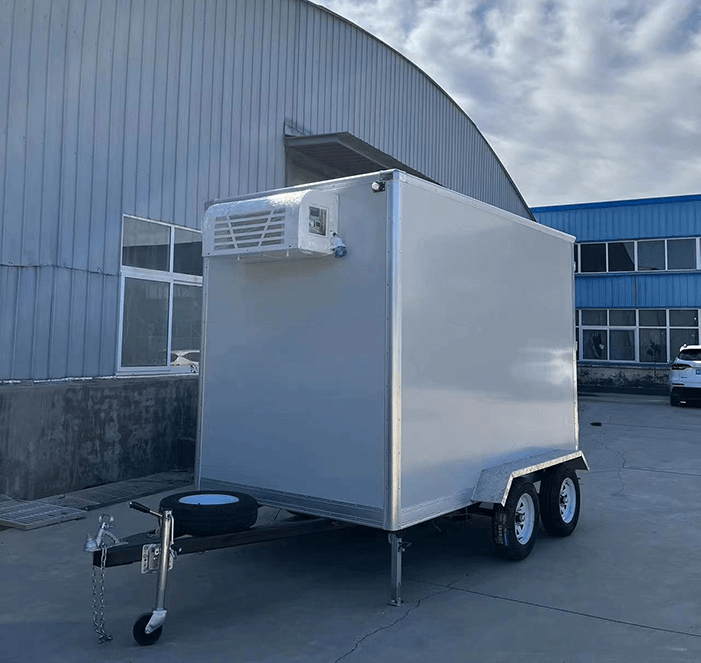
Traditional diesel-powered refrigerated trailers have long been plagued by issues such as high noise levels, significant emissions, and complex maintenance requirements. Today, the industry is rapidly transitioning toward electrification and the use of auxiliary clean energy sources. Modern portable refrigerated trailers typically feature fully enclosed electric compressors and highly efficient insulated bodies; they offer "plug-and-play" functionality via standard mains power connections, completely eliminating reliance on fossil fuels. Some high-end models incorporate solar-assisted power systems, utilizing roof-mounted photovoltaic panels to recharge battery packs during both stationary periods and transit. This effectively extends operational duration while ensuring zero on-site emissions and silent operation. Furthermore, IoT-based smart temperature control systems have become standard features; operators can remotely set temperatures, monitor internal environmental changes in real-time, and receive fault alerts via mobile devices, thereby significantly reducing the risks associated with human error and cargo damage. The use of lightweight composite materials reduces the trailer's curb weight while enhancing thermal insulation, keeping temperature fluctuations within a tighter range and ensuring stability across various temperature zones—from standard freezing to deep-freeze applications.
Expanding Applications: From Fresh Food Transport to Flexible Adaptation Across Diverse Scenarios
The value of portable refrigerated trailers has long since transcended the traditional definition of a "road transport vehicle." In the food service and outdoor events sectors, these trailers grant operators unprecedented autonomy. Event organizers can prepare meals in commercial kitchens, load finished products directly into the refrigerated trailer, and—upon arrival at the site—simply connect to a power source to maintain freshness. This provides a comprehensive catering solution for music festivals, sporting events, wilderness camps, and more. In the healthcare sector, portable refrigerated trailers are becoming reliable vehicles for the "last-mile" delivery of vaccines, blood products, and specialized medications; their mobility and independent temperature control make them particularly suitable for supplying remote areas or temporary medical facilities. During natural disasters or public health emergencies, these trailers can rapidly convert into emergency cold-storage units, effectively mitigating the risk of cold-chain disruptions in affected areas. At the agricultural source, freshly harvested fruits and vegetables can be immediately loaded into the trailers for pre-cooling, locking in freshness at the point of origin and significantly reducing post-harvest losses. From bustling urban commercial districts to remote wilderness areas, and from routine distribution to emergency relief, portable refrigerated trailers are integrating into the very fabric of societal operations with remarkable flexibility.
Industry Outlook: Green Compliance and Smart Connectivity Shaping the Future
Amidst increasingly stringent global environmental regulations, the green transformation of portable refrigerated trailers is not merely a market choice but an imperative for compliant development. Key trends in R&D include the adoption of eco-friendly natural refrigerants, improved energy efficiency, and the reduction of the total lifecycle carbon footprint. Simultaneously, the wave of smart technology is transforming refrigerated trailers from simple "hardware" into "data terminals." Onboard sensors record real-time data—such as temperature profiles, door-opening frequency, and location—which is transmitted via the cloud to management and dispatch platforms. This enables value-added services like visual traceability, intelligent scheduling, and predictive maintenance. The industry widely anticipates that future portable refrigerated trailers will integrate deeply with emerging business models—such as autonomous delivery and shared leasing—serving as pivotal nodes within the smart cold-chain ecosystem. Driven by consumption upgrades and a growing emphasis on quality, portable refrigerated trailers—capable of meeting rigorous temperature control standards while balancing cost-efficiency and environmental sustainability—are poised for significant growth, injecting a steady stream of green momentum into the enhancement of quality and efficiency in global cold chain logistics.