
Ensuring Lifeline Safety: Dedicated DC Electric Air Conditioning Solves Ambulance Parking Cooling Challenges
As the global healthcare system accelerates its green and low-carbon transformation, electric ambulances are gradually becoming the new mainstay of urban emergency response. However, amidst this electrification wave, a critical technical challenge concerning patient safety and emergency care quality is becoming increasingly prominent—how to provide stable, powerful, and quiet cooling for the ambulance cabin while parked or traveling at low speeds?
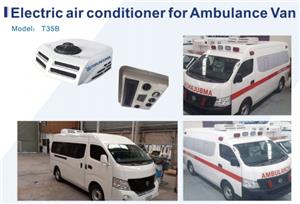
Recently, a new achievement in global thermal management technology has attracted industry attention. The launch of a high-performance DC electric air conditioning system specifically developed for electric commercial vehicles, especially ambulances, is providing a new solution to this problem, marking a new milestone in mobile medical rescue environmental protection capabilities.
Electrification Creates New Demands: Independent Air Conditioning Becomes Standard in "Life Cabins"
Traditional ambulance air conditioning systems largely rely on internal combustion engines. However, when electric ambulances arrive at the emergency scene, await transfer, or undergo in-hospital handover, the engine is typically off. At this point, relying solely on the vehicle's original electric air conditioning system is often insufficient to maintain power for all medical equipment while providing sustained, high-power independent cooling for the rear medical compartment.
For emergency medications requiring constant temperature storage, patients urgently needing cooling due to high fever, and medical personnel wearing heavy protective suits, high temperatures not only mean discomfort but can also directly threaten treatment effectiveness and safety. Therefore, an independent electric air conditioning system capable of operating independently of the vehicle's power source and drawing power directly from the vehicle's high-voltage battery has become a necessity for modern "mobile ICUs."
Technological Innovation: Balancing Powerful Cooling and Quiet Operation
For this specific scenario, the new generation of dedicated air conditioning systems has undergone deep optimization in its technical architecture. Its core lies in achieving efficient adaptation to the vehicle's high-voltage platform, enabling it to draw energy directly from the power battery without starting the "engine," outputting a powerful cooling capacity sufficient to cover the entire medical compartment.
This capability completely changes the previous predicament of "not daring to turn on the air conditioning while parked, or being able to keep it on for long." Whether the vehicle is waiting under the scorching sun or frequently starting and stopping during transport, the cabin maintains a constant and comfortable temperature environment, providing physical assurance for the effectiveness of emergency medications and creating more stable life support conditions for patients.
Of particular note is the extreme control of noise. Emergency scenes require a relatively quiet environment for auscultation, communication, and stabilizing the patient's emotions. The roaring noise of traditional generators or high-powered air conditioners often becomes a source of interference. The new system, through the introduction of intelligent frequency conversion technology and efficient sound insulation design, can automatically enter a low-noise operation mode after reaching the set temperature. This "powerful yet quiet" characteristic not only reduces auditory and visual stimulation for patients but also provides emergency personnel with a more focused atmosphere for rescue, truly embodying the "human-centered" emergency care philosophy.
Integrated design "lightens the load" on the space-constrained medical cabin.
The interior space of an ambulance is extremely valuable, needing to accommodate stretchers, ventilators, monitors, and other life support equipment. Therefore, any additional equipment must adhere to the principles of high integration and space saving.
The new generation of dedicated air conditioning systems is designed with this in mind, employing a compact, top-mounted or integrated structure that not only saves valuable floor and cabinet space but also blends seamlessly with the vehicle's structure. Its casing can be adapted to match the vehicle's paint scheme, achieving overall aesthetic consistency. Simultaneously, the system supports deep integration with the vehicle's existing control network, allowing medical personnel to easily adjust it via the driver's side panel or rear-cabin controller, achieving seamless switching between driving and parking conditions.
Furthermore, the introduction of a fresh air function is a major highlight. In the context of normalized epidemic prevention and control, continuously introducing filtered fresh air into the cabin effectively reduces the risk of cross-infection and improves air quality during long-distance transport, providing dual health protection for both medical staff and patients.
A New Chapter in Green Rescue: Balancing Environmental Protection and Efficiency
In today's increasingly stringent environmental regulations, the new generation of ambulance air conditioning systems also reflects industry responsibility in its choice of refrigerant. Using environmentally friendly refrigerants to reduce potential impacts on the global climate has become a consensus in technological upgrades. This not only aligns with the global healthcare system's commitment to sustainable development but also adds a footnote to the construction of green emergency medical systems in cities.
From a broader perspective, the emergence of high-performance electric dedicated air conditioners is not merely an iteration of a single product. It addresses the shortcomings of electric ambulances in environmental control under special operating conditions, making the application scenarios of new energy vehicles in the crucial field of emergency medical care more comprehensive. When emergency responders are no longer distracted by "battery anxiety" and "insufficient cooling," they can concentrate all their energy on the life urgently needing care inside the ambulance.
With the acceleration of global urbanization and the continuous improvement of public health system requirements, the function of emergency vehicles is profoundly evolving from the single function of "rapid transport" to "mobile medical units." In this evolution, breakthroughs in specific technologies like high-performance DC electric air conditioners act as solid foundations, silently supporting peace of mind and coolness in every race against time to save lives. It is not only technological progress, but also a meticulous care and respect for every life.