
Electric Parking Air Conditioners for Trucks Gain Traction, Solving “Idling Fuel Waste” and Boosting Green Freight
In long‑haul road transportation, a long‑overlooked source of energy waste and emissions is finally being addressed by technological advances. For years, truck drivers resting during breaks, spending the night in their cabs, or waiting to load or unload cargo have had to keep their large diesel engines idling for extended periods just to run the vehicle’s original air conditioner and maintain a comfortable cab temperature. This practice not only wastes a staggering amount of fuel but also produces massive exhaust emissions and noise pollution, posing a stubborn challenge to the green transformation of the freight industry. In recent years, electric parking air conditioners for trucks have rapidly matured and been widely adopted. By providing a clean, quiet, and efficient alternative, these systems are tackling the idling dilemma, improving drivers’ working and living conditions while injecting new momentum into reducing carbon and pollutant emissions in the transport sector.
From “Idling Fuel Waste” to “Cooling by Electricity” – A Fundamental Shift
Conventional truck cab air conditioners are driven directly by the engine via a belt‑driven compressor, meaning that the engine must keep running whenever cooling is needed. For long‑distance drivers, the fuel consumed by idling the engine all night during summer is far from negligible, and both the fuel cost and the extra engine wear cause considerable concern. Even worse, prolonged idling leads to incomplete combustion, producing high levels of pollutants that directly affect air quality and the health of people in relatively crowded areas such as truck stops, logistics parks, and service stations.
Electric parking air conditioners fundamentally change this pattern. They use an independent electrically driven compressor and a brushless DC motor, powered by an on‑board battery pack, completely decoupled from the truck’s main engine. While the vehicle is moving, the alternator or the engine charges the battery. When the truck is parked with the engine off, the driver simply presses a switch, and the electric air conditioner can run for hours or even all night solely on battery power. Throughout this process, the engine remains off – no fuel is burned, and no exhaust is produced. Moreover, because the engine – the main source of noise – is eliminated, the electric air conditioner runs at very low sound levels, generating little more than the soft whisper of fan blades. This creates a quiet, restful environment for drivers.
Mature Technology and Wide Compatibility
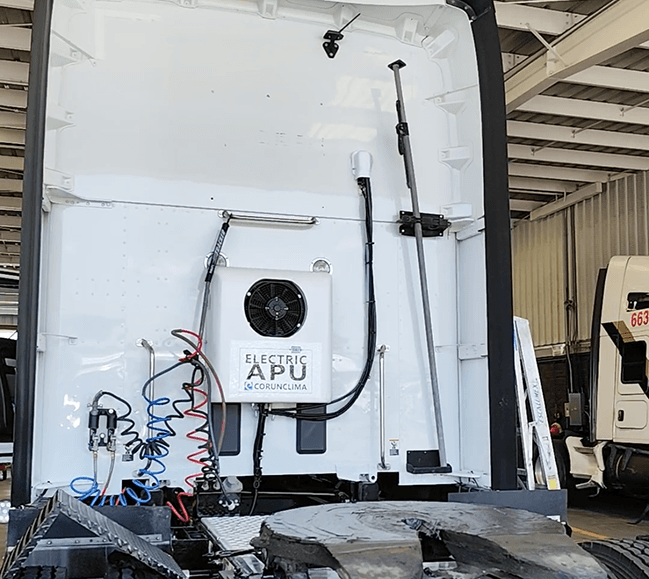
Electric parking air conditioners for trucks currently fall mainly into two technical categories: integrated and split systems. Integrated units combine the compressor, condenser, evaporator, and control electronics into one compact assembly mounted directly on the back wall of the cab or in the roof opening. They are easy to install and offer a clean, streamlined appearance. Split systems retain the traditional layout with separate indoor and outdoor units. The outdoor unit can be concealed behind the cab’s roof fairing, while the indoor unit is integrated into the headliner or side wall. Split systems generally provide higher cooling capacity and are suitable for heavy‑duty trucks that demand more powerful air conditioning.
In terms of power supply, the mainstream solution uses a lithium‑iron‑phosphate battery pack paired with an intelligent power management system. The battery charges automatically while the truck is driving and powers the air conditioner when parked. The charging and discharging process is fully automatic, requiring no manual intervention from the driver. Advanced power management modules continuously monitor the battery’s state of charge, ensuring that the truck always has enough power to start and drive normally. Some high‑end models also support recharging via external mains power or solar panels, further expanding energy sourcing options.
Policy Support and Market Demand Accelerate Adoption
As more regions impose strict limits on diesel truck idling, and as standards for green service areas and low‑carbon logistics parks increasingly encourage the use of parking air conditioners, these electric systems are moving from optional extras toward standard equipment. Meanwhile, truck drivers are paying greater attention to their own health and rest quality. The low noise and zero exhaust emissions of electric parking air conditioners significantly reduce cabin carbon dioxide levels and vibration transmitted from the engine, thereby improving both sleep quality and driving safety.
From an economic standpoint, although the upfront cost of an electric parking air conditioner and its battery pack is higher than that of a conventional unit, the savings on fuel and engine maintenance typically recoup the investment in a relatively short period. The whole‑lifecycle economic benefits are clear. A growing number of new trucks now offer electric parking air conditioners as a factory‑optional or even standard feature. The retrofit market for existing trucks is also thriving, and the entire industry is rapidly moving toward a consensus: when you buy a truck, you equip it with an electric parking air conditioner.
Looking Ahead: Comfort, Green, and Intelligence in One
With continuous improvements in electric drive efficiency, battery energy density, and intelligent control algorithms, electric parking air conditioners for trucks are evolving toward greater efficiency, smarter operation, and better user experience. In the future, these systems will be deeply integrated with on‑board telematics, enabling functions such as remote scheduled start/stop, temperature adjustment based on the driver’s daily routine, and coordination with window shades and sunroofs – becoming an integral part of the smart truck cab. It is foreseeable that electric parking air conditioners will become standard equipment on road freight trucks, just like airbags and power windows. Millions of truck drivers will be able to enjoy a clean, quiet, economical, and comfortable resting environment in every hot summer or cold winter. This is not merely a technological upgrade; it is a tangible improvement in the professional dignity and quality of life of countless freight workers, and a solid step forward as the transportation industry moves toward a green, low‑carbon future.