
Cold Chain Logistics Undergoes Transformation: Portable Refrigerated Trailer Technology Enters a New Era of Green Intelligence
As global food trade continues to expand and standards for pharmaceutical cold chains become increasingly rigorous, portable refrigerated trailers—a critical component of cold chain logistics—are undergoing a profound, technology-driven transformation. From green innovations in power systems to the digital upgrading of temperature control management, this traditional mode of transport is gradually evolving into a "mobile cold storage unit" that integrates eco-friendliness, intelligence, and efficiency, thereby constructing a more reliable technological defense for safeguarding the quality of fresh produce and the safety of pharmaceuticals.
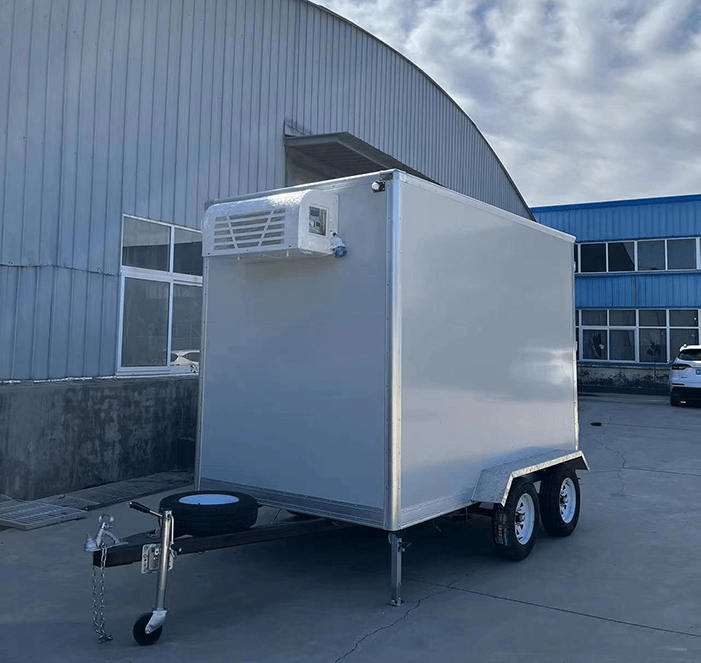
Green Power Drives the Industry's Future Direction
Driven by increasingly stringent environmental regulations and a global consensus on carbon emission reduction, the power sources for refrigerated trailers are rapidly shedding their reliance on traditional energy. For a long time, independent diesel-powered refrigeration units served as the mainstream configuration; however, the emissions generated during their operation—along with their high energy consumption costs—have consistently remained pain points for the industry. Today, breakthroughs in new energy technologies are changing this landscape.
The rise of fully electric refrigerated trailer technology represents the core direction of the industry's green transition. By integrating high-energy-density battery packs with advanced energy management systems, these trailers can power their refrigeration units continuously and independently, without the need to start a diesel engine. Of particular note is the introduction of "generator axle" technology in certain cutting-edge designs; this innovation converts the vehicle's kinetic energy—generated while in motion—into electrical energy, thereby replenishing the battery in real-time and enabling self-sustaining power autonomy during long-haul transport. This "self-sufficient" energy model allows refrigerated transport operations to achieve zero-emission status throughout the entire process—from warehouse loading and urban distribution to scheduled rest stops—offering dual benefits by simultaneously improving urban air quality and reducing the carbon footprint of logistics enterprises.
Concurrently, the transition to eco-friendly refrigerants has emerged as a pivotal element in this technological upgrade. The industry is gradually phasing out traditional refrigerants with high Global Warming Potential (GWP) in favor of newer, more environmentally benign alternatives. This shift not only aligns with the requirements of international environmental conventions but also establishes a solid technological foundation for the sustainable development of cold chain logistics.
Deep Integration of Precision Temperature Control and Intelligent Management
Within the technological evolution of portable refrigerated trailers, the precision of temperature control capabilities and the intelligence of management systems are becoming the primary benchmarks for measuring product competitiveness. For perishable foods requiring long-distance transport—or for highly temperature-sensitive biological agents—even minute fluctuations in compartment temperature can result in irreversible quality degradation. Consequently, achieving absolute uniformity and stability in compartment temperature has become a primary focus of technological innovation.
Modern, advanced refrigerated trailers are no longer content with mere cooling or thermal insulation; instead, through optimized airflow designs and multi-zone independent control systems, they achieve differentiated temperature control across various locations within the compartment. This technology effectively eliminates the "localized temperature disparity" phenomenon common in traditional refrigerated vehicles—a problem where areas near the refrigeration unit become excessively cold while deeper sections fail to cool sufficiently. Through precise airflow management, cold air is distributed uniformly to every corner of the cargo space, ensuring that the entire load remains within an equally high-quality, temperature-controlled environment.
The deep integration of digital technologies has effectively equipped refrigerated trailers with a "smart brain." Today, telematics systems have become a standard feature in high-end refrigerated trailers. A network of sensors distributed throughout the vehicle body collects critical data in real-time—including internal temperature, humidity, refrigeration unit operational status, and door opening frequency—and synchronizes this information to the cloud via an IoT platform. Logistics managers can monitor the real-time status of in-transit cargo at any moment using a computer or mobile device; should any temperature anomalies or signs of equipment malfunction arise, the system automatically issues alerts, guiding drivers or dispatch centers to intervene promptly and thereby preemptively eliminate potential risks of cargo damage. This model of end-to-end transparent management not only enhances the reliability of cold chain logistics but also provides the technical foundation necessary to meet increasingly stringent regulatory requirements for food and pharmaceuticals.
Structural Optimization and Enhanced Multi-Scenario Adaptability
Beyond power and control systems, the structural design of the refrigerated trailer body itself is also undergoing continuous optimization. The application of lightweight materials allows trailers to effectively reduce overall vehicle weight—while still maintaining sufficient structural strength and thermal insulation performance—thereby boosting transport efficiency and cargo capacity. Concurrently, the widespread adoption of modular design principles enables refrigerated trailers to flexibly adjust their internal layouts and temperature zone configurations to suit diverse cargo types and transport requirements, thereby better adapting to a wide spectrum of cold chain logistics scenarios.
Against the backdrop of accelerating urbanization and the growing prevalence of e-commerce delivery services, refrigerated trailers must now also navigate increasingly complex operational environments. Urban distribution places increasingly stringent demands on vehicles regarding low noise and zero emissions, while long-haul intercity transport puts equipment durability and reliability to the ultimate test. Thanks to comprehensive technological advancements, modern refrigerated trailers are now capable of seamlessly adapting to a wide array of operational scenarios—satisfying end-to-end cold chain requirements ranging from farm fields to supermarket shelves, and from pharmaceutical production facilities to vaccination sites.
It is foreseeable that, driven by continuous breakthroughs in new energy, intelligent control, and advanced materials technologies, portable refrigerated trailers will continue to push the boundaries of current performance. Adopting a greener, smarter, and more efficient profile, they will safeguard the inherent freshness of every food item and the potency of every dose of medicine, thereby injecting a ceaseless stream of momentum into the global cold chain logistics ecosystem.