
Cold Chain Logistics Turns "Green": Solar and Electric Technologies Revolutionize Portable Refrigerated Trailers
As global demands for food preservation and pharmaceutical safety become increasingly stringent, portable refrigerated trailers—core equipment for temperature-controlled transportation—are undergoing an unprecedented green technology revolution. Refrigeration units that once relied on the roar of diesel engines are being replaced by quiet batteries and clean solar energy. From technological research and development to practical application, a series of innovations indicate that the zero-emission era of cold chain logistics is accelerating.
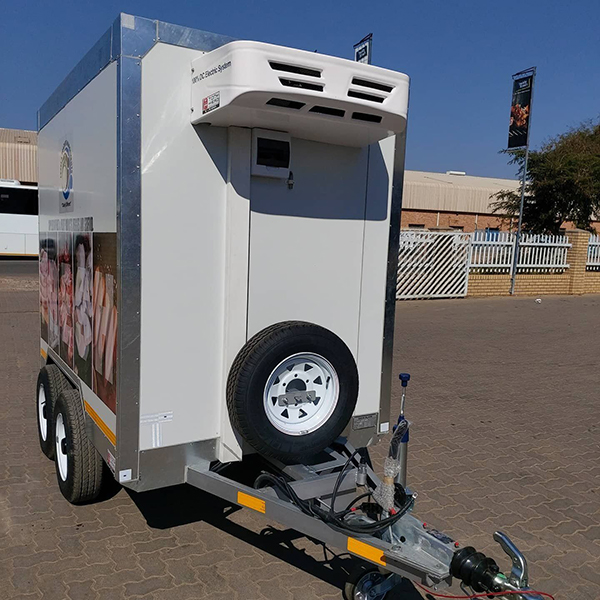
Solar-Assisted Charging: Paving the Way for Trailer Self-Sufficiency
For a long time, ensuring continuous refrigeration of refrigerated trailers during long-distance transport or when stationary without increasing fuel consumption has been a challenge for the industry. Now, this dilemma is being overcome by solar-assisted technology.
Leading manufacturers have launched solar-assisted electric refrigerated trailers, integrating solar-assisted technology into traditional all-electric platforms. The solar panels on the roof do not completely replace traditional charging but act as "efficiency enhancers," continuously replenishing the battery during daily operation to extend the running time after a single charge. This intelligent power management system supports multiple charging methods, enabling flexible recharging at venues, construction sites, and temporary parking spots, truly achieving zero on-site emissions and a convenient plug-and-play experience. These products are primarily targeted at scenarios such as event refrigeration, emergency response, remote construction sites, and the transportation of agricultural products and pharmaceuticals, capable of stably maintaining the required temperature range for various goods.
Meanwhile, the industry is also exploring deeper paths to "energy independence." Some innovative solutions integrate renewable energy-driven concepts into their design. The trailers not only integrate rooftop solar panels but also feature energy-recovery axles. When the vehicle is moving or braking, the axles convert previously wasted kinetic energy into electrical energy, which is stored in the onboard high-voltage battery system. It is estimated that the solar panels can meet a significant proportion of the energy required for refrigeration, depending on sunlight and usage conditions. This means that under certain ideal operating conditions, the trailers can even achieve energy self-sufficiency. Compared to traditional diesel refrigeration units, this solution not only significantly reduces operating costs but also fundamentally eliminates carbon emissions and noise pollution.
Full Electrification: Saying Goodbye to the Diesel Era
The exploration of solar energy is one path the industry is taking, but another, more radical technological route—purely electric refrigeration units that completely abandon diesel engines—has also been validated in practice. Some of the world's leading supply chain companies have begun deploying trailers equipped with fully electric refrigeration systems in their fleets.
These systems completely eliminate the diesel engine, replacing it with energy recovery axles and battery storage systems to ensure power supply. This means that the refrigeration system can operate continuously and reliably, whether the trailer is in motion or stationary for extended periods after being separated from the tractor, completely eliminating dependence on fossil fuels. Industry insiders point out that seeing refrigeration units operate smoothly without traditional diesel engines proves that sustainability and high performance can coexist.
Among major European manufacturers, electrification has become a clear strategic direction. In addition to launching fully electric refrigerated semi-trailers, some manufacturers are also equipping new refrigeration units with electric interfaces, enabling perfect compatibility with electric trucks and achieving zero-emission operation from tractor to trailer. Meanwhile, to cope with increasingly stringent environmental regulations, the industry is widely adopting new environmentally friendly refrigerants with lower global warming potential to replace traditional, highly polluting refrigerants. Market feedback shows that just a few years ago, fully electric refrigerated trucks were extremely rare, but now, companies that do not offer sustainable solutions are immediately at a competitive disadvantage when bidding for projects.
Market Trends: Digitalization and Intelligentization in Parallel
Beyond the innovation of power sources, refrigerated trailers themselves are becoming increasingly "intelligent." This growth is driven not only by advancements in hardware technology but also by an extreme pursuit of operational transparency and cargo safety.
Today, telematics has become a standard feature of new trailers. Through onboard intelligent systems, fleet managers can monitor real-time temperature changes within the trailer, equipment operating status, and vehicle location. This not only helps fleets anticipate risks and make proactive decisions, significantly reducing the possibility of cargo spoilage, but is also a key tool for meeting increasingly stringent food safety regulations and pharmaceutical distribution standards. In cold chain transportation, even slight temperature fluctuations can affect the efficacy of pharmaceuticals and the quality of food, and intelligent monitoring provides reliable assurance for end-to-end traceability.
Looking ahead
As global environmental regulations continue to tighten and carbon neutrality goals are being pursued more deeply, portable refrigerated trailers are evolving from a simple combination of an insulated box and a diesel engine into high-tech mobile cold storage integrating materials science, power electronics, and the Internet of Things. While high initial purchase costs and varying charging infrastructure in some regions remain obstacles to widespread adoption, as pilot data from early adopters gradually demonstrates its economic viability and reliability, zero-emission refrigerated transport may become the new normal in the industry within the next decade. In this green revolution, whether transporting life-saving vaccines or preserving everyday food, the ultimate beneficiaries will be every consumer in the global supply chain. When the cold chain no longer emits black smoke, our food safety and the future of our planet will be better guaranteed.