
Ambulance DC Electric Air Conditioner – Bringing Cool Relief to the Lifesaving Corridor
On the front lines of emergency medical services, time is life, and the environment is a critical part of care. For ambulances that race through cities and countryside in scorching summers and freezing winters, the temperature inside the patient compartment directly affects the vital signs of the patient and the concentration of medical personnel. In recent years, as emergency medical systems demand higher professionalism and human-centric design, the DC electric air conditioner for ambulances has evolved from a supporting feature into a core standard, leading a technological shift in onboard medical environment control.
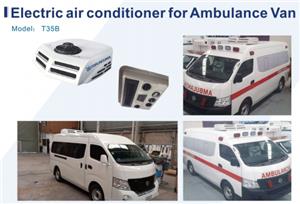
The Dilemma of Traditional Systems: The Cost of Idling
Conventional ambulance air conditioners rely on the vehicle’s engine to drive the compressor. This means that once the engine is turned off, the air conditioning stops. On hot summer days, when an ambulance arrives at the hospital or waits between calls, paramedics often have to let the engine idle for long periods just to keep the patient compartment cool. This practice not only burns excess fuel and increases operating costs, but also generates exhaust fumes that can accumulate and cause secondary pollution for patients and the surrounding environment. More worryingly, prolonged idling accelerates carbon buildup, wears down key engine components, and reduces vehicle reliability – and reliability is the lifeline of any emergency response.
DC Electric Air Conditioner: Independent Operation as a Game Changer
The arrival of the DC electric air conditioner has fundamentally changed this situation. It uses an independent electric drive system, powered by the vehicle’s battery or an auxiliary battery pack, requiring no engine operation to provide cooling or heating. Whether parked at an ambulance station, stuck in traffic, or standing by for hours at an accident scene, the patient compartment can always maintain a comfortable temperature. This feature is especially valuable for intensive care ambulances – stable temperature control significantly reduces the patient’s heat stress and creates stable conditions for infusions, monitoring, defibrillation, and other life-saving procedures.
From a technical perspective, the DC electric air conditioner integrates a high-efficiency DC compressor, a brushless blower fan, and an intelligent temperature control module. Compared to traditional belt-driven mechanical compressors, the electric compressor starts and stops more smoothly and adjusts speed more precisely, allowing it to bring the compartment to the desired temperature in a very short time.
Quiet Operation and Energy Efficiency: Dual Advantages
Because it no longer depends on engine idling, the air conditioner operates with greatly reduced noise when the ambulance is moving quietly through the city or on a nighttime call. This avoids disturbing residents in the neighbourhood and provides a quieter space for communication between paramedics and patients inside the vehicle.
Energy efficiency and environmental friendliness are another outstanding advantage of the DC electric air conditioner. In electric drive mode, energy utilization is significantly higher than that of traditional mechanical transmission plus refrigeration cycle systems. Some systems also support additional functions such as stationary charging and solar-assisted charging, further reducing dependence on fossil fuels. For urban public health systems promoting green healthcare and low-carbon emergency response, this technology holds significant strategic value.
Enhanced Safety: Another Layer of Protection for Life
In terms of safety and reliability, the DC electric air conditioner also performs excellently. The independent electronic control system eliminates the risk of air conditioning failure due to engine problems. The fully enclosed structure reduces the probability of refrigerant leakage. Fire‑retardant materials and overload protection circuit designs provide a higher level of safety for medical supplies such as oxygen and alcohol, which are often present inside the ambulance.
A Promising Future: Moving Toward an Intelligent Climate Control Era
With the rapid advancement of electric and intelligent emergency vehicles, the DC electric air conditioner is entering a broader application space. Whether retrofitting conventional fuel‑powered ambulances or designing new energy electric ambulances from the factory floor, DC air conditioning has become a key element in improving the quality of emergency medical services. In the future, with intelligent temperature control algorithms and remote pre‑cooling / pre‑heating functions, ambulances will be able to automatically adjust the compartment temperature in advance based on dispatch orders – truly achieving “comfortable as you board, worry‑free on the way.”
The ambulance DC electric air conditioner is more than just a cooling and heating device. It represents a thoughtful commitment to life within the emergency medical rescue system. With quiet yet powerful performance, it safeguards every journey from the scene to the hospital, keeping the lifesaving corridor comfortably cool in summer and pleasantly warm in winter.