
A New Species in Cold Chain Logistics: How Portable Refrigerated Trailers are Rewriting the Rules of Logistics
In today's world, where the demands for freshness and timeliness of perishable goods are increasingly stringent, a silent yet profound transformation is taking place in the capillaries of the logistics system. A new type of equipment that combines both constant temperature storage and road mobility – the portable refrigerated trailer – is quietly reshaping the boundaries and rules of the cold chain industry with its unique form and logic.
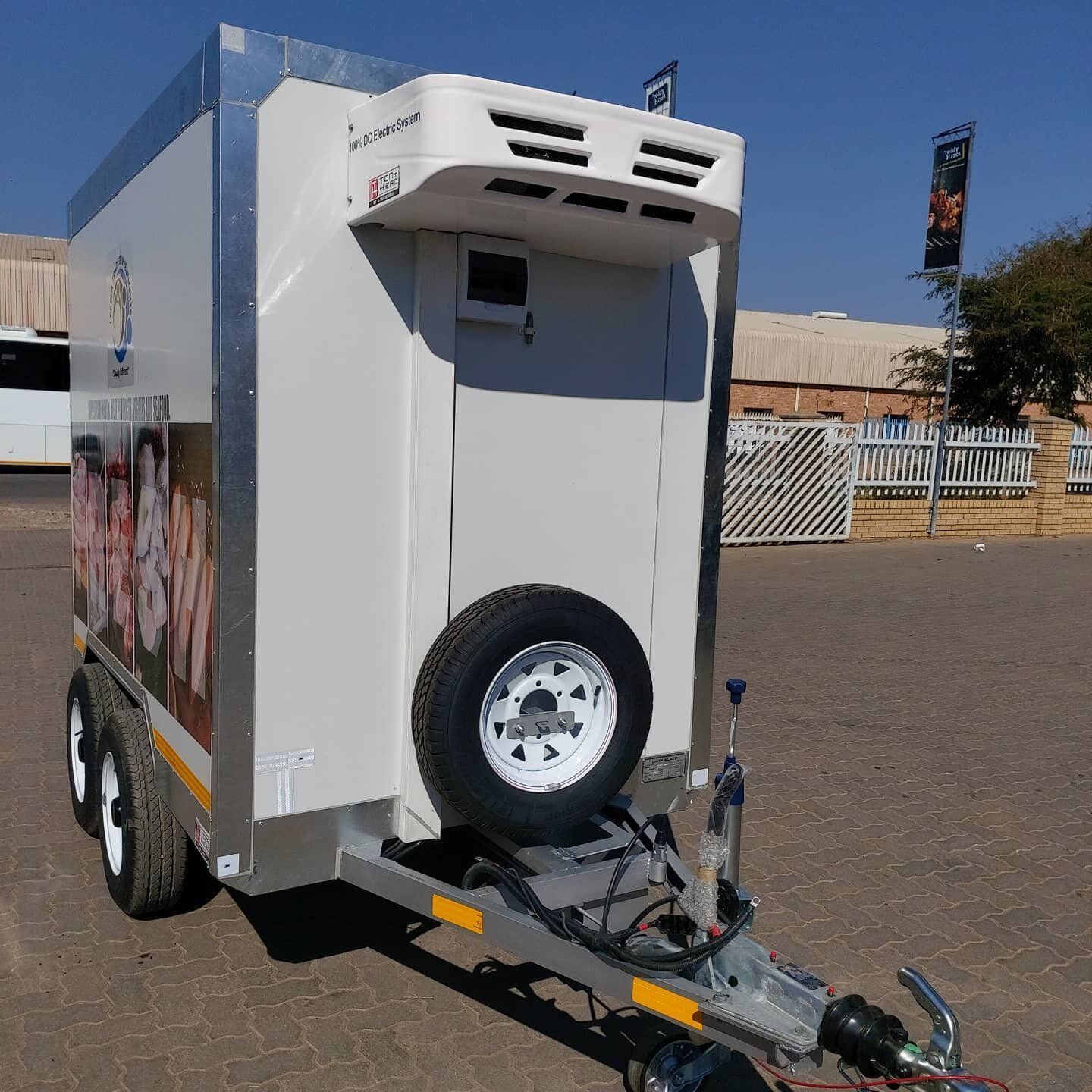
Ending the Pain of "Broken Links": From Linear Relay to a Complete Closed Loop
Traditional cold chain logistics relies on a linear relay model of "fixed cold storage - refrigerated trucks," where goods are inevitably exposed and delayed between transfer points, constituting the weakest link in the quality assurance chain. The fundamental innovation of the portable refrigerated trailer lies in combining a "mobile cold storage unit" with a "transport unit." It has an independent, precise temperature control system, ensuring that goods remain in a continuous, stable, and sealed environment from loading to unloading at the final destination. This design fundamentally eliminates the unavoidable temperature control "gaps" in traditional models, simplifying complex multi-stage coordination into a standardized, self-contained "quality closed loop," achieving truly seamless end-to-end cold chain protection.
Reconstructing Spatial Logic: From Fixed Nodes to Flowing Blood
A more profound transformation lies in its rewriting of the spatial attributes of cold chain infrastructure. With its standardized interfaces and self-contained structure, the portable refrigerated trailer can be flexibly towed to fields, ports, community streets, or temporary distribution points. This allows cold chain resources to be released from expensive, fixed storage nodes and transformed into "mobile units" that can be deployed and configured dynamically as needed. For upstream producers, it is a "pre-cooling workstation" that can be moved to the production site, enabling immediate preservation after harvesting; for downstream retailers, it is a "flexible front-end warehouse" that can precisely respond to demand. This paradigm shift from "trucks finding warehouses" to "warehouses coming to where they are needed" creates a highly flexible and responsive agile logistics network. III. Intelligent Core: From Temperature Control to Data Trust
Driving this transformation in hardware form is the intelligent "soft" power hidden within. Modern portable refrigerated trailers are essentially intelligent nodes in the Internet of Things. Through integrated sensing and communication systems, they transform the real-time status of the microenvironment inside the container into a continuous, transparent data stream. Managers can remotely monitor the temperature trajectory and every door opening and closing, creating an unalterable, traceable record of the entire process. Thus, cold chain management has evolved from vague control based on experience to precise decision-making based on data. More importantly, this fully verifiable data trail is building a solid and trustworthy foundation for market credibility in the circulation of highly quality-sensitive goods such as fresh produce and pharmaceuticals.
Leveraging the Industry Ecosystem: Lowering Barriers and Promoting Democratization
The popularization of portable refrigerated trailers is quietly changing the participation landscape and value distribution of the cold chain industry. In a relatively lightweight and modular way, it provides high-standard cold chain service capabilities comparable to traditional heavy-asset layouts. This significantly lowers the entry barrier to high-quality cold chain services, enabling small and medium-sized trading companies, agricultural cooperatives, and even individual farmers to integrate into the modern cold chain system in a more flexible and economical way. This trend not only promotes the "democratization" of cold chain services but also drives the supply chain towards a flatter and more efficient direction. At the same time, as a standardized functional module, it greatly facilitates the seamless connection of multimodal transportation by road, rail, and sea, providing a key technical support point for building an integrated, global, and efficient cold chain network.
Looking Ahead: Defining New Infrastructure for Resilient Logistics
Although challenges remain in areas such as standardization and cross-organizational collaboration, the "mobile, modular, and intelligent" direction represented by portable refrigerated trailers clearly indicates the core path of future logistics infrastructure evolution. The future logistics system will no longer consist of a large number of isolated fixed facilities, but rather will be composed of countless such intelligent mobile units dynamically combined and operating collaboratively. They are like Lego bricks, jointly building a new logistics ecosystem with strong resilience and the ability to quickly respond to uncertainty.
This seemingly not-so-large "mobile container" is silently and steadily expanding the boundaries of modern logistics capabilities with its unique flexibility. What it brings is far more than just improved efficiency; it's a completely new vision of mobility, certainty, and connectivity. As the foundation of the cold chain shifts from static to dynamic, the world we envision—one of efficient, fresh, and interconnected goods—is rapidly becoming a reality.